
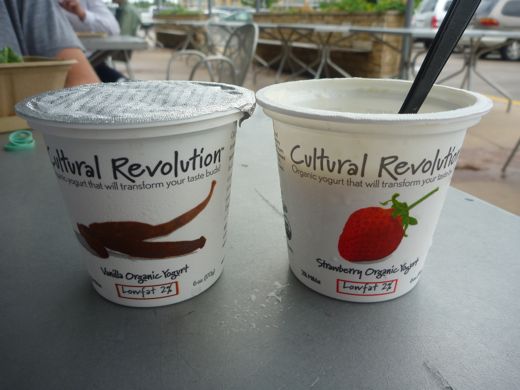
Few foods offer more health benefits than yogurt. In addition to being a great source of protein and calcium, it provides live & active cultures, which are beneficial for many reasons, primarily because they promote healthy digestion & can boost immunity (there are lots of wannabe immune-boosting foods out there; yogurt is a real one). You can even eat yogurt if you’re lactose-intolerant; it may actually help you digest!
Not all yogurts are created equal. Some are healthy, but others have so much sugar and so many additives, they should barely be considered yogurt.
Facts to help you choose a good yogurt:
- Plain yogurt has about 12g of naturally-occurring sugar per cup— this is from lactose, a natural component of milk, and is not the same as refined sugar. Even tart, unsweetened yogurt contains this lactose, so don’t let it scare you off.
- A teaspoon of sugar = 4grams. So for example, if you buy a cup of yogurt that has 32 grams of sugar (like regular Yoplait or a grocery store-brand), that means it has 8 whole teaspoons of sugar in just one serving— chances are you would never feel comfortable adding this much sugar into anything, so why would you eat it in yogurt?!
- If you’re not into the tart taste of yogurt,add your own honey, maple syrup, fruit preserves, berries, or other chopped fruit (this is a much healthier than buying pre-sweetened yogurt, as you’ll add less sugar). Aim for a little (1 tsp) then add more if you need to. Or, mix a few tablespoons of a flavored yogurt into plain, to get the benefits of both.
- Frozen yogurt from a yogurt shop, even if it’s nonfat and or sugar-free, is not as beneficial as regular yogurt. It’s definitely better than ice cream, and better than many commercial yogurts, but keep in mind it’s still a dessert, and it tastes that good for a reason.
- “Tart” frozen yogurt, from Pinkberry & other yogurt shops, is not unsweetened. It’s actually very high in sugar (32g in a 8oz serving, which is usually the smallest cup-size), they just add citric acid to make it taste tart.
Here are some of my favorite types — they are not only tasty, but healthy:

Siggi’s Skyr Icelandic Yogurt
Siggi’s “skyr” is a thick, tart, flavorful yogurt, with a hint of sweetness. They offer all sorts of unique flavors, like orange-ginger, pomegranate-passionfruit, and grapefruit. High in protein (16g) and low in sugar (10g) — very rare in a yogurt. Only drawback to Siggi’s is it’s $2.99/6 oz container. But a great occasional indulgence.

Fage 0% Greek Yogurt
Fage is one of the original Greek yogurts in the U.S. It comes in Total (full fat), 2% (reduced fat), and 0% (fat free). Go for the fat-free & plain — it’s so thick & creamy you won’t feel any sacrifice. If you want sweetness, add a teaspoon of honey or chopped fruit rather than buying the sweetened type; that way you can control the amount of sugar and calories added.
Note: Trader Joe’s sells a generic 0% Greek yogurt–it’s Fage only with a Trader Joe’s label–and about half the price.
Trader Joe’s European Style Fat-Free Yogurt
This yogurt is thinner than Greek, but is equally creamy and delicious. It’s still high in protein (14g) and low in sugar (10g), and tasted very tart. Add 1-2 teaspoons maple syrup to a cup if you prefer a sweeter yogurt (even adding your own sweetener will keep yogurt much lower in calories and sugar than if you buy sweetened yogurt).

Stonyfield Organic Yogurt
I love almost all of Stonyfield’s yogurts. The milk comes from family farms in Vermont and the yogurts are super high quality. Some of them are pretty sweet, so if you buy a fruit-on-the-bottom one, leave the fruit-at-the-bottom. Or, mix a little of the fruity yogurt into a larger amount of plain.
Other brands to check out (Read the Nutrition Label before buying — look for less than 20g/sugar per 6-oz cup — and even less is best!)
- Mountain High — Plain fat-free, Plain lowfat, Lowfat Vanilla (esp if you mix w/ plain)
- Cascade Fresh — Even the flavored ones are lower in sugar than other commercial fruit yogurts
- Brown Cow — Plain fat-free, Plain Lowfat, Maple Lowfat
- 365 (Whole Foods brand) Lowfat and fat-free varieties
- Wallaby Organic — some flavors are lower in sugar than others–read the label
- Oikos (Stoneyfield’s Greek Yogurt) — all flavors are good & pretty low in sugar
Yogurts I recommend avoiding:
- Yoplait Regular
- Yoplait Custard Style
- Dannon regular
- Ralph’s, Von’s, Safeway, Kirkland Signature, etc. — these regular fruit-flavored yogurts are super high in sugar and calories
- “Light” yogurts — these are reduced calorie, but sweetened with aspartame (Nutra-Sweet) and contain many additives. If you need sweet, these are a better choice than regular versions calorie-wise, but not necessarily healthy.




20 Comments
Kristin
January 12, 2010 at 9:12 amAny thoughts/recommendations on the Greek Yogurt at Trader Joes?
Miss you!! – Kristin
AMELIA (MEELS)
January 29, 2010 at 8:53 amSorry for the very late response Kristin! I love the Trader Joe's Greek Yogurt, that's what I primarily buy. I recommend going with the 0% or 2% and adding your own sweetener. Isn't TJ's great?!
Bill
July 22, 2010 at 7:16 pmAnd for those of us who eat a lot of yogurt and can’t afford the sky high prices some yogurts cost – just make it yourself. In no time at all, I make 3 – 4 quarts of yogurt every couple of days – yes we eat a lot of yogurt. And it just costs the price of milk. And you can reproduce just about any yogurt on the market today – one we like a lot is a combo of Bulgarian, Activia and Chobani cultures although Activia by itself is really good.
http://mryogurt.info/
Bill
Nicole Vierzba
July 27, 2010 at 3:13 pmDo you have this “Carbmaster” Yogurt where you live?
It’s made by Kroger/Ralph’s (store-brand).
I love it because it’s low in sugar, high in protein…and the vanilla is really good when mixed with a spoonful of natural peanut butter! 🙂
http://www.wellsphere.com/healthy-living-article/what-i-love-kroger-carbmaster-yogurt/1034866
Marlon Braccia
July 30, 2010 at 11:52 amGreat post, Amelia! I’m so glad you clarified for people what constitutes yogurt that is worth eating and the fakers like Dannon and Yoplait. I’d like to add Brown Cow to your list of plain yogurts that have no added sugar and a concentration of active cultures.
I often substitute yogurt for the higher fat ingredients, mayo and sour cream. A dab gives a great tang to guacamole.(how to video at http://www.youtube.com/yogimarlon#p/u/4/rEdU9g8gTcg) Believe it or not, I use 1/2 yogurt and half mayo in potato salad. No one ever suspects and it’s much, much healthier.
Keep the great info coming, Amelia and happy day!!
Melissa
March 26, 2011 at 7:33 pmI love the Fage0% and 1 tablespoon of the dark chocolate peanut butter mixed with it, so good!
Becky Kirshman
January 26, 2012 at 11:51 amMy Grandson from age 1 has vomited violently when given dairy. We had switched him to regular milk instead of formula. He has suffered severe constipation ever since we changed to Lactaid. So stool softener & laxatives everyday. I had heard there are some cheeses & yogurts he could have. My question is what about soy milk & yogurts? Are they better for him & will it help with his constipation? The Doctors say baby’s can’t be lactose intolerant. But we have tried 2 %, 1 % & fat free milk all with similar results. Any help would be appreciated. Thank you
Becky Kirshman
January 26, 2012 at 11:54 amMy grandson is lactose intolerant. I was wondering about soy milk & yogurts? Could you please suggest some cheeses I can get at just a regular grocery store? Thank you
Amelia
February 3, 2012 at 3:46 pmHi Becky, people who are lactose intolerant normally have gas, bloating, sometimes even diarrhea after eating dairy. They can usually have yogurt or kefir (cultured milk products — because in these products there are good bacteria that help with digestion). If your grandson is vomiting after dairy, it’s more likely that he has a severe food allergy rather than lactose intolerance, and I’d suggest you talk to your doctor or a dietitian about how to proceed. In the meantime, definitely help him avoid dairy foods!
Amelia
February 3, 2012 at 3:48 pmHi Becky. If your grandson is vomiting after dairy, it’s more likely that he has a severe food allergy rather than lactose intolerance, and I’d suggest you talk to your doctor or a dietitian about how to proceed. It’s true that babies can’t be lactose intolerant to their own mother’s milk, but when you’re talking about milk from other animals they can definitely be lactose intolerant or allergic. You could try soy, rice, or coconut milk products, but I really recommend seeing a specialist about this — trial and error will be so hard for his little system! Good luck!
susan
June 10, 2013 at 6:31 pmHas anyone tried activia? It is another kind of yogurt. It seems like it would be up there with all the other yogurts that are helpful.
Amelia
June 12, 2013 at 9:01 amThere are a few concerns with Activia in my opinion: 1) not organic – so the milk is from cows fed GMO & pesticide-laden feed, and may not have been raised in healthy conditions. 2) lots of sugar and unnecessary additives. 3) Not any more effective at improving digestion than other real yogurts with live active cultures. In general, probiotics and live bacteria will help promote good digestion – doesn’t need to be Activia. Thanks for your comment, Susan 🙂
TT335i
July 3, 2013 at 7:42 pm“Yogurt. The good bacteria (live, active cultures) found in yogurt will digest the lactose for you. Choose a high quality yogurt (here’s a guide to help) with very few ingredients, or Greek yogurt, which has less lactose to begin with.”
How can “Greek” style yogurt have “…less lactose to begin with.”?
Greek style yogurt uses milk to make the yogurt, just like any other yogurt, unless the yogurt is made using non bovine/cow milk.
SInce nearly all major brand America yogurt is made with cow milk, including “Greek” style, how is it possible that the milk used to make “Greek” style yogurt has “less” lactose to begin with?
“Greek” style yogurt is simply a strained yogurt, nothing new or different there.
It starts as regular yogurt that is then strained to remove the left over water/moisture that is in yogurt. That results in a thicker product, which has a consistency closer to sour cream, and it has more protein because the yogurt is concentrated due to the straining process.
One more thing, this whole “Greek” thing is nothing more than marketing to Americans.
Not all nor most of the yogurt made in Greece is strained yogurt. Greeks eat regular yogurt just like in other countries.
Personally, I’m not a fan of strained yogurt. It’s hard to eat because it does have the consistency of sour cream. I can’t eat sour cream by the spoonful either.
Daniel
July 23, 2013 at 10:38 amWhat you say yourself suggests an answer to your own question, “How can ‘Greek’ style yogurt have less lactose to begin with?”
Because, when you say the process of making ‘Greek’ yogurt (good to know that not all Greek yogurt is like that) includes *straining* ‘regular’ yogurt, then it sounds like lactose gets flushed out while water is being removed.
At the following website,
http://healthyeating.sfgate.com/can-lactose-intolerant-eat-yogurt-aged-cheese-6130.html
look for “Yogurt and Cheese”. There they talk about this so-called ‘Greek-style’ yogurt agreeing with what I propose. Makes sense, doesn’t it?
According to them, ‘Greek’ has 6.8 grams and ‘regular whole-fat’ has 8.5 grams [‘non-fat’ has 14 grams] of lactose per 8-ounce serving. So compared to whole-fat yogurt, ‘Greek’ does not have much less lactose. But never forget that some of the regular yogurt might be refurbished with lactose for better taste.
Amelia
July 23, 2013 at 2:48 pmDifferent Greek yogurt brands have different amounts of lactose. It’s always best to read the label on the type you buy.
laur
August 22, 2015 at 2:48 pmsooo Amelia… i basically have pretty bad diarrhea after eating any kind of dairy product (the kind of d thats liquidy and burns your ass). sometimes i just eat dairy because i like the taste so much (ice cream, cheese, yogurt, etc)…even though afterwards, i usually have to go back and forth to the toilet.
it wasn’t always like this…while growing up, i used drink about 3-5 cups of milk a day. i stopped during my sophomore year in high school when my mom said i was drinking too much. started to drink it again in my junior year…that’s when i started to have problem. i just couldn’t drink milk anymore. a vanilla milkshake from burger king (one of my fav things to drink back then) was basically equivalent to an hour of sitting on the toilet and squirming bc my ass was on fire.
so am i lactose intolerant? or did i develop a milk allergy? i’ve always tried experimenting with different dairy products. i even tried to torture myself by drinking regular milk…thinking it was just a phase and maybe my body just had to get used to it again…but unfortunately, my ass just burned. :~/ just had a strawberry and blueberry chobani yogurt smoothie from smoothie yesterday and i was not only gassy throughout the afternoon, but in pain all throughout the night. worst feeling ever. i’ve had a kidney stone once. i honestly can’t tell which is worse.
i’ve tried various probiotics, different yogurts, supplements and more…nothing helps/seems to digest properly. i’m @ a loss. what do you recommend?
Amelia Winslow
August 23, 2015 at 12:09 pmHi there,
I would highly recommend consulting your doctor or a Registered Dietitian to get some answers. From your description of your symptoms, you could be lactose intolerant, allergic to dairy, or have something else going on digestively. In the meantime, before getting some professional advice, sounds like you could benefit from avoiding dairy products. Luckily there are now tons of great dairy-free options on the market – and you can even make yogurt easily at home! My friends Willow & Stephanie have a great video here on how to make coconut yogurt at home: https://www.youtube.com/watch?v=CamClfW7Eis
K J
January 12, 2016 at 5:31 pmThank you very much. As a lactose intolerant person I highly appreciate this article.